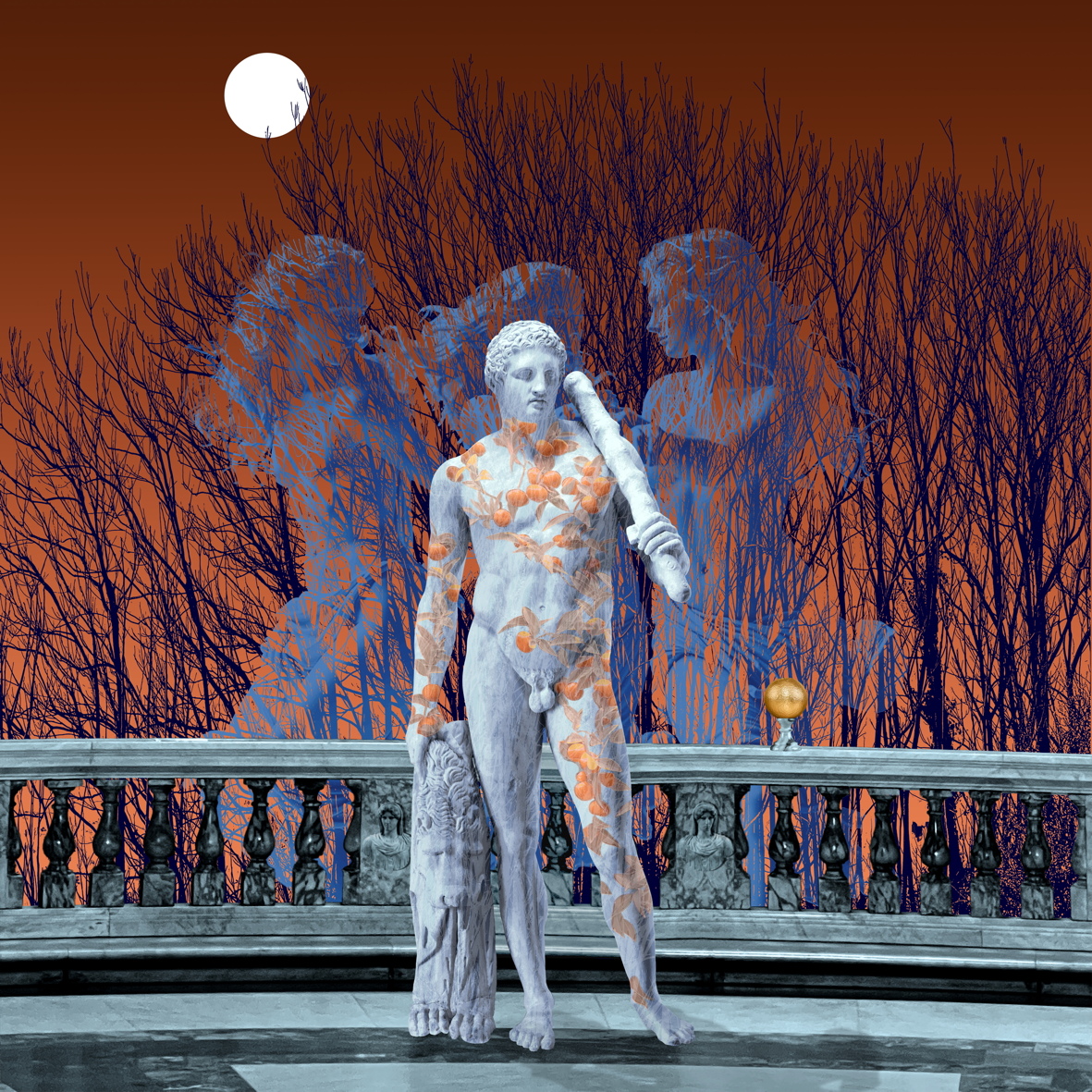
In Heracles in the Hesperides Garden, mythology is not merely represented—it is cunningly inverted. At first glance, Hercules appears as the classical paragon of labor and virility, stationed solemnly in a marble courtyard beneath a blood-red twilight. Yet a closer look reveals a curious contradiction: while the surrounding trees are ghostly and bare, stripped of leaf and fruit, Hercules himself bears the lush harvest. His stone skin is inscribed with golden apple motifs—tattoo-like emblems of the very bounty he was tasked to retrieve.
Here, the mythic labor has not only marked him; it has quite literally become him. The garden’s treasures have been transplanted from nature to flesh, from landscape to body. Hercules doesn’t just carry the memory of the Hesperides—he wears their fruit like a trophy and a stain. It's as if, in the absence of living growth, he has absorbed the myth’s fertility into his own frame. The apples no longer hang from trees—they bloom from a man.
This sly reversal recasts the hero not only as conqueror of nature, but as its unwilling surrogate. He is the bearer of a legacy that can no longer be cultivated, a monument who has become the orchard. One might say the trees went on strike—and their golden offspring took refuge in marble.
The ghostly silhouettes behind him, representing the Hesperides and the three goddesses of the future Judgment of Paris, form a silent tribunal. They haunt the hero’s back not as passive muses but as watchful witnesses. Between them and the lone golden apple set upon the balustrade, Hercules finds himself encircled by a web of mythic femininity—revered, desired, and scrutinized.
Visually, the piece navigates a surreal mise-en-scène: the natural world is skeletal, the divine is spectral, and the human is overripe with symbolism. The digital brush reanimates myth with a distinctly contemporary wit. This is not a straightforward tribute to antiquity—it is a commentary on cultural inheritance, gendered power, and the strange ways myths metabolize across time.
In this garden, heroism is lonely, fruitfulness is ironic, and the prize is both a burden and a brand. Hercules no longer labors for the apples—they labor upon him.